
Delivery expectations have compressed. The customer of an ecommerce no longer compares lead times only with other ecommerce, but with the experience of the large marketplaces that have made same-day delivery feel normal. micro fulfillment is one of the operational answers to this pressure: bringing stock closer to the customer to shorten lead times. But it is not a universal solution, and understanding when it really pays off avoids poorly calibrated investments.
What micro fulfilment means
Kitting micro fulfillment is a logistics model that distributes stock across small nodes close to demand, instead of concentrating it in a single large centre. The idea is to reduce the distance between product and end customer, compressing delivery times and last-mile costs. It does not necessarily replace the main warehouse: it often sits alongside it, hosting the highest-rotation references in the areas with the highest order density.
Micro fulfilment centre vs traditional fulfilment centre
A traditional fulfilment centre is a large centre that manages the entire assortment and covers a wide territory, optimised for storage efficiency and volumes. A micro fulfilment centre is a compact structure, close to urban centres, that hosts a selected assortment to serve a local catchment quickly. The first relies on economies of scale, the second on proximity. In practice the two models coexist: the main centre feeds the local nodes, which handle rapid delivery.
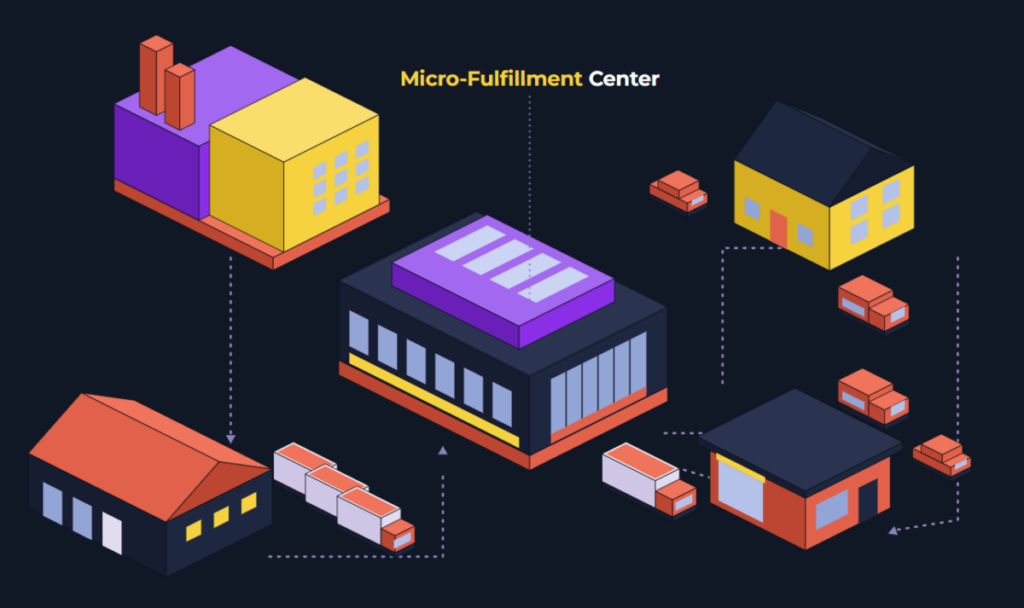
How a micro fulfilment model works
The model revolves around three elements. First, assortment selection: the local nodes hold the highest-rotation references, the ones that justify proximity. Second, stock allocation, which decides how much product to keep in each node based on forecast local demand. Third, order routing, which assigns each order to the node able to fulfil it fastest. Everything rests on inventory management that maintains single visibility over distributed stock.
Distributed stock, proximity to the customer and lead times
Distributing stock reduces fulfilment times because it shortens the order's physical journey, but it introduces complexity: more nodes mean more points to replenish, more risk of misalignment between physical and system stock and greater difficulty in balancing stock across sites. The advantage in speed exists only if allocation and routing are governed precisely. Without this control, the distributed model generates more stockouts, not fewer.
Are you evaluating whether micro fulfillment is worthwhile?
Micro fulfilment and same day delivery
Same day delivery is the most cited use case of micro fulfilment, because physical proximity is the prerequisite to genuinely shorten lead times. Same day delivery is not achieved by speeding up the carrier, but by reducing the order's distance at departure. This is why local nodes enable delivery windows that a single national centre can hardly guarantee. It remains a service to calibrate, though: it makes sense where order density justifies it, not as a generic promise across the whole territory.
Same day delivery and modern ecommerce expectations
The expectation of speed has grown, but it is not uniform. In some categories and urban areas same day delivery is a concrete competitive factor; in others the customer prioritises cost or reliability over pure speed. Designing micro fulfilment also means deciding where speed pays and where a centralised model remains more efficient, avoiding the cost of a distributed network where it generates no perceived value.
Micro fulfilment in an omnichannel setup
Micro fulfilment expresses its potential within an omnichannel logic.Local nodes can coincide with stores or spaces that serve online orders and pickups together, enabling models such as ship-from-store. In this scenario, proximity stock serves multiple channels at once, and management requires a single view of stock across the whole network. A coherent omnichannel strategy is what prevents distributed nodes from turning into disconnected silos.
Want to understand if micro fulfilment makes sense for your ecommerce?
When micro fulfilment pays off: operational signals and volumes
Micro fulfilment pays off when several signals coexist: geographically concentrated demand, an assortment with clearly identifiable high-rotation references, delivery times that have become a competitive factor and volumes sufficient to saturate the local nodes. Conversely, with dispersed demand or low volumes, the centralised model remains more efficient.